
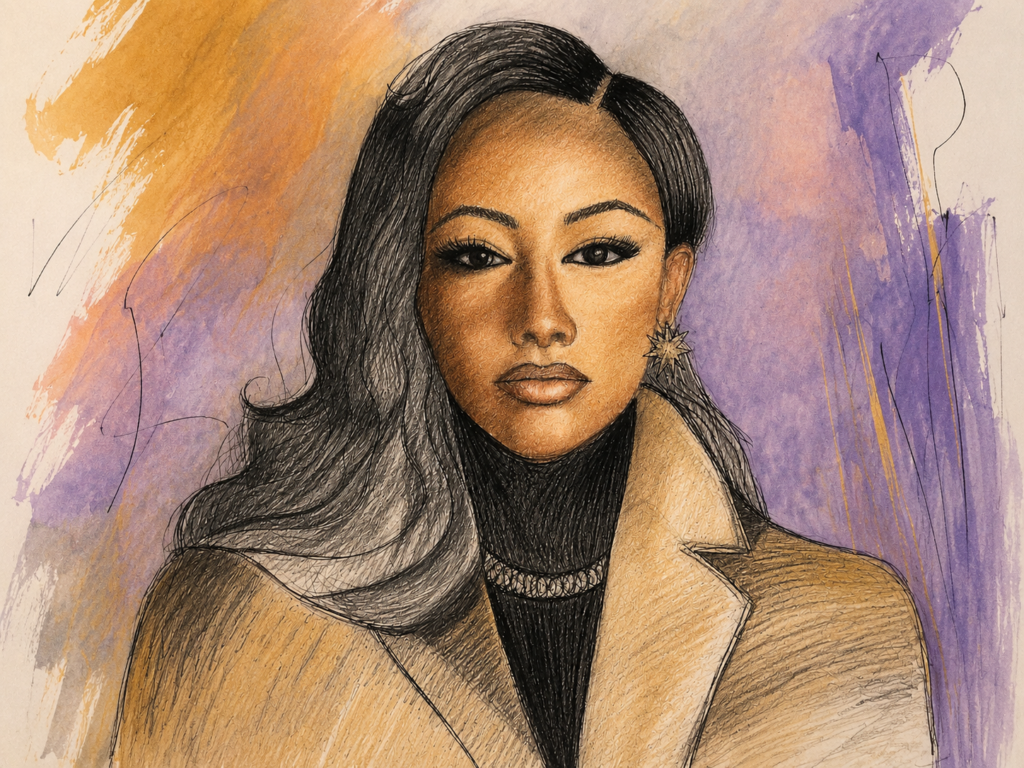
On a crowded congressional hearing floor, with cameras fixed and tensions rising, Jasmine Crockett leaned forward—not for spectacle, but for clarity. Her voice did not waver, because truth does not require theatrics. It requires conviction. And in that moment—watched, dissected, and debated in real time—she stood not merely as a participant in the proceedings, but as a reminder that accountability is not optional in a democracy; it is its foundation.
There was a time in this country when testimony before Congress carried the weight of consequence. When words spoken under oath were expected to align with truth, not convenience. When those entrusted with oversight understood that their duty was not to posture, but to protect the integrity of the institution itself. Congresswoman Barbara Jordan embodied that era—an era where clarity of purpose and moral authority were not rare, but required.
Jasmine Crockett stands in that lineage, and she also echoes the spirit of Shirley Chisholm—“Unbought, Unbossed” and unwilling to shrink in the face of expectation. Chisholm did not simply serve in Congress; she challenged the boundaries of possibility by running for president, asserting that leadership was not reserved for the few deemed acceptable, but for those bold enough to claim it.
Political victories may be counted in ballots, but political significance is measured in courage—the courage to speak plainly when obfuscation is rewarded, to question when silence is safer, and to insist upon truth when falsehood has become normalized. It is also measured in determination—the steady, unrelenting drive to persist, to push forward, and to remain committed even when the path is uncertain or resistance is strong.
Congresswoman Jasmine Crockett has become one of those figures who does not merely occupy space, but defines it.
Whether history ultimately defines her by legislative accomplishments, courtroom precision, public advocacy, or the unmistakable force of her voice, she represents something that extends beyond a single campaign. She stands in a long tradition of Black women who have accepted extraordinary public scrutiny while refusing to diminish themselves to meet it—a tradition shaped not only by Barbara Jordan, but by Shirley Chisholm’s insistence on climbing higher, even when the path was not designed for her ascent.
Throughout American history, Black women have carried movements, organized communities, mobilized voters, and fortified democratic participation—often without recognition, often without protection. Yet when the opportunity arises for leadership at the highest levels, they are met not only with scrutiny, but with shifting standards.
This is not new.
What is new is the refusal to accept it quietly.
The public conversation surrounding Crockett’s Senate campaign revealed more than political disagreement. It revealed a discomfort with directness, with authority, with a voice that does not ask permission to be heard. Her communication style, her confidence, her willingness to confront—these became subjects of debate not because they were unfamiliar, but because they were unapologetic.
And so we must ask, as Barbara Jordan once compelled this nation to do—and as Shirley Chisholm demonstrated through action: What standard are we applying, and to whom?
Who is permitted to be forceful?
Who is expected to be agreeable?
Who is praised for conviction, and who is penalized for it?
These are not rhetorical questions. They are measures of our collective integrity.
Recognition, then, is not a passive act. It is a deliberate one.
It asks us to see beyond outcomes.
It asks us to acknowledge effort.
It asks us to recognize contribution—not selectively, but honestly.
It asks us to remember that before any individual arrives at the starting line, there has already been a journey marked by resistance, persistence, and preparation.
From local leadership to the Texas Legislature and ultimately to the United States Congress, Crockett has demonstrated that public service is not an accident. It is the result of discipline, education, advocacy, and an unwavering commitment to participation—even when participation is met with opposition. Like Chisholm before her, there is an unmistakable sense that the climb is not finished—that ambition, when rooted in purpose, does not settle.
History does not advance because one individual succeeds alone.
It advances because individuals insist upon expanding the boundaries of possibility.
Every generation inherits doors opened by someone who was told those doors were not meant for them.
Every generation benefits from those who endure criticism without surrendering their voice.
In that sense, public service itself demands recognition—not as a reward, but as an acknowledgment of its necessity.
For many Black women across America, Crockett’s visibility represents more than representation. It represents affirmation—the affirmation that their intellect, their authority, and their leadership are not anomalies, but assets.
Recognition is not agreement.
Recognition is acknowledgment.
It is the understanding that a person’s presence has altered the conversation, whether one agrees with their position or not.
It is the recognition that history is shaped not only by those who prevail, but by those who redefine what leadership can look like.
As I continue creating portraits of influential Black women, I am reminded that each image is not merely representation—it is a record. It serves as a testament. It is evidence that presence matters, that contribution matters, that truth matters.
Long after campaign advertisements fade and election maps are archived, what remains are the individuals who insisted upon expanding the nation’s understanding of leadership.
That is why I choose to enshrine contribution before history has the opportunity to forget the effort required to make it.
The measure of a life in public service is not confined to electoral outcomes.
Sometimes its greatest achievement is ensuring that the next generation encounters a door that is no longer closed.
That is not incidental.
That is intentional.
That is history.
And that—without qualification—deserves recognition.
Article and Art by Lillian L Thompson