
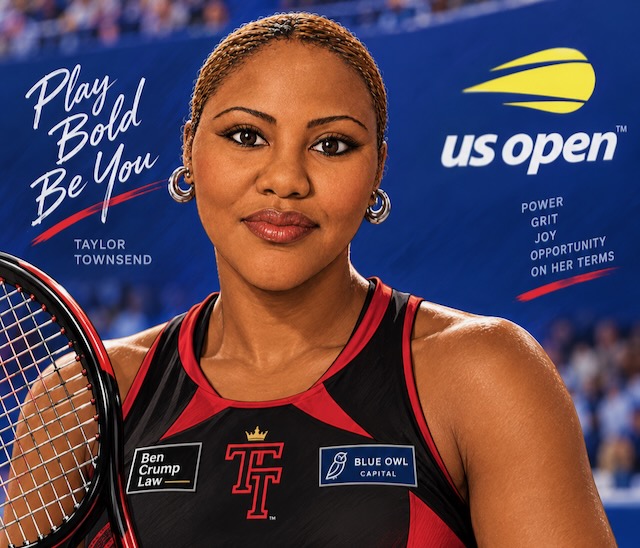
Taylor Townsend walked onto the courts of the 2026 US Open carrying more than a tennis racquet. Her success—reaching the fourth round in singles and winning the women’s doubles championship—belongs to a much longer story about Black women and the environment surrounding professional tennis.
Black women did not simply have to become excellent at tennis. At different points in history, they had to overcome the conditions surrounding excellence: exclusion from courts, lack of training resources, inadequate financing, racial and gender stereotypes, scrutiny of their bodies, and a commercial system in which winning and marketability were not always treated as the same thing.
That history helps us understand why Townsend’s achievements matter.
First, You Had to Get on the Court
Tennis developed with close associations to wealth, social status, private clubs and exclusivity. For Black players in segregated America, talent could not overcome a locked clubhouse door.
The Black community created its own infrastructure. The American Tennis Association, founded in 1916, provided competition and development opportunities when mainstream tennis excluded Black players.
Althea Gibson emerged through that system. By the late 1940s she was dominating Black tennis, but many qualifying tournaments leading to major national competition were played at segregated clubs. Advocacy eventually helped Gibson enter the U.S. National Championships in 1950.
Then she proved what exclusion had been keeping outside.
Gibson became the first Black player to win a Grand Slam singles championship and ultimately won five Grand Slam singles titles and eleven Grand Slam titles across singles, doubles and mixed doubles.
Yet trophies did not produce financial security. Gibson competed during an amateur era when prize money was limited, while race further restricted commercial opportunities. Her family recalled that friends including Joe Louis and Sugar Ray Robinson sometimes helped with travel and hotel expenses.
She could be celebrated as a champion without being economically treated like one.
That distinction—between recognition and reward—survived long after segregation ended.
Excellence Still Wasn’t Enough
By Zina Garrison’s generation, Black women could enter the tournaments Gibson had fought to open. But access to competition did not mean equal access to the business surrounding it.
Garrison developed her game at Houston’s public MacGregor Park rather than through the traditional country-club pipeline. She became one of the world’s finest players, reaching No. 4 and defeating Monica Seles and defending champion Steffi Graf on her way to the 1990 Wimbledon final.
Yet Garrison later recalled spending five years without a clothing sponsorship. She watched lower-ranked white players receive opportunities unavailable to her. At Wimbledon in 1990, Martina Navratilova supplied her with clothing from her Nike collection. Garrison finally received a Reebok agreement during her run to the final.
The barrier had changed.
Gibson needed someone to open the gate. Garrison was inside the gate, winning, but still had to convince corporate America that her excellence possessed commercial value.
Venus and Serena Changed the Economics
Then Venus and Serena Williams arrived.
They did more than dominate tennis. They altered assumptions about what Black female athletes could represent commercially.
Reebok signed teenage Venus to a reported five-year, $12 million agreement in 1995—before she had won a professional tournament. A corporation was investing not simply in what a young Black player had accomplished, but in what it believed she could become.
After Venus won Wimbledon, the US Open and Olympic gold in 2000, her next Reebok agreement was reportedly worth approximately $40 million. She eventually moved beyond endorsement into ownership, developing her own fashion and activewear brand, EleVen.
Serena pushed the economics further. In 2003, after establishing herself at the top of women’s tennis, she signed a Nike agreement reportedly worth up to $55 million with performance incentives.
The Williams sisters demonstrated that Black women could command tennis culturally as well as competitively—through fashion, personality, audience, business and influence.
Corporate recognition had finally begun to approach athletic achievement.
From Champion to Brand
Naomi Osaka and Coco Gauff inherited a different commercial landscape.
Their accomplishments are their own, but the marketplace receiving them had been transformed by what came before.
New Balance signed Gauff to a multiyear agreement in 2018 when she was only fourteen. She was an outstanding junior but had not yet won a senior Grand Slam championship. The company was investing in her future. Eventually, Gauff would have her own signature tennis shoe.
Osaka similarly emerged in an era when a woman of color could become an international commercial personality extending far beyond tennis.
But progress is rarely a straight line.
Enter Taylor Townsend.
When the Body Doesn’t Fit the Image
Townsend became the world’s No. 1 junior in 2012. Normally that achievement would identify a young player as one of America’s most promising professional prospects.
Instead, controversy developed around her fitness and weight. The USTA withheld financial support for tournament expenses while encouraging Townsend to improve her conditioning.
The controversy raised a question extending beyond one teenager:
What is a female tennis champion supposed to look like?
Townsend’s career supplied its own answer.
She developed a distinctive left-handed game built around aggressive net play, touch, angles and improvisation. She became the world’s No. 1 doubles player and, by 2026, a multiple Grand Slam doubles champion.
Yet another familiar obstacle remained.
Townsend has said that she repeatedly sought an apparel sponsor and encountered rejection. Her Nike relationship ended in 2017. Instead of continuing to wait for a corporation to determine her marketability, she began developing clothing under her own name.
That may represent the newest stage in this history.
From Access to Ownership
Look at the progression. Wealth building was not dependent on tennis wins but on the endorsements without them friends and family had to help.
Althea Gibson fought for access to competitive stages.
Zina Garrison demonstrated that ranking and achievement did not necessarily produce commercial recognition.
Venus and Serena Williams transformed the economics by demonstrating the enormous market value of Black female excellence.
Naomi Osaka and Coco Gauff entered an environment in which corporations could recognize a woman of color not merely as an athlete to sponsor after she became a champion, but as a global brand.
Taylor Townsend introduces another possibility:
Ownership.
Her doubles success gives her championships. Her singles run give her broader exposure. Television coverage, major matches, interviews, fashion and social media expand recognition. Her apparel line “TT” gives her something different from an endorsement contract—the opportunity to collaborate with professional street style fashion designers and apply her direct customer sales runway entry to the tennis courts. The apparel approach was launched at the 2026 US Open for economic value created by her identity. (https://www.instagram.com/explore/search/keyword/?q=taylor%20townsend)
While tennis nevertheless remains an expensive sport. Townsend still has marketability. Long before a young player earns prize money, someone must finance coaching, equipment, tournament fees and travel. And after reaching professional tennis, rankings and championships exist alongside another, less objective judgment Taylor has career earnings at $10.3 Million+. This level of earnings over 14 years places her ‘firmly in the upper crust of historic WTA earnings despite never winning a single major.’
That is why Taylor Townsend belongs to a story that began long before she was born. One of constant obstacles but because of her enormous talent and personality triumphs over past cultural patterns. This is her time.
The question confronting Black women in tennis has evolved:
Will they let us play? I directly challenged Billie Jean King requesting that they embrace Taylor Townsend and support her career through social media. She has a unique play style that many appreciate.
Will they recognize our excellence? Yes, a larger audience has been brought into the tennis world through Venus and Serena along with fewer barrier and social media expansive support.
Will they invest in us? Hit and Miss but not a showstopper for reaching new followers and customers who appreciate her as a mother and tennis player as well as her fierceness.
And perhaps now:
What happens when we invest in ourselves?
Taylor Townsend’s 2026 US Open achievements represent more than another successful tournament. They are the latest chapter in a long negotiation between Black excellence and a tennis establishment repeatedly forced to reconsider who belongs, who gets recognized, who gets financed—and ultimately, who gets to determine the value of a champion.
Article and art image created by Lillian L Thompson with AI enhancement.
Visit https://lillianonline.us