
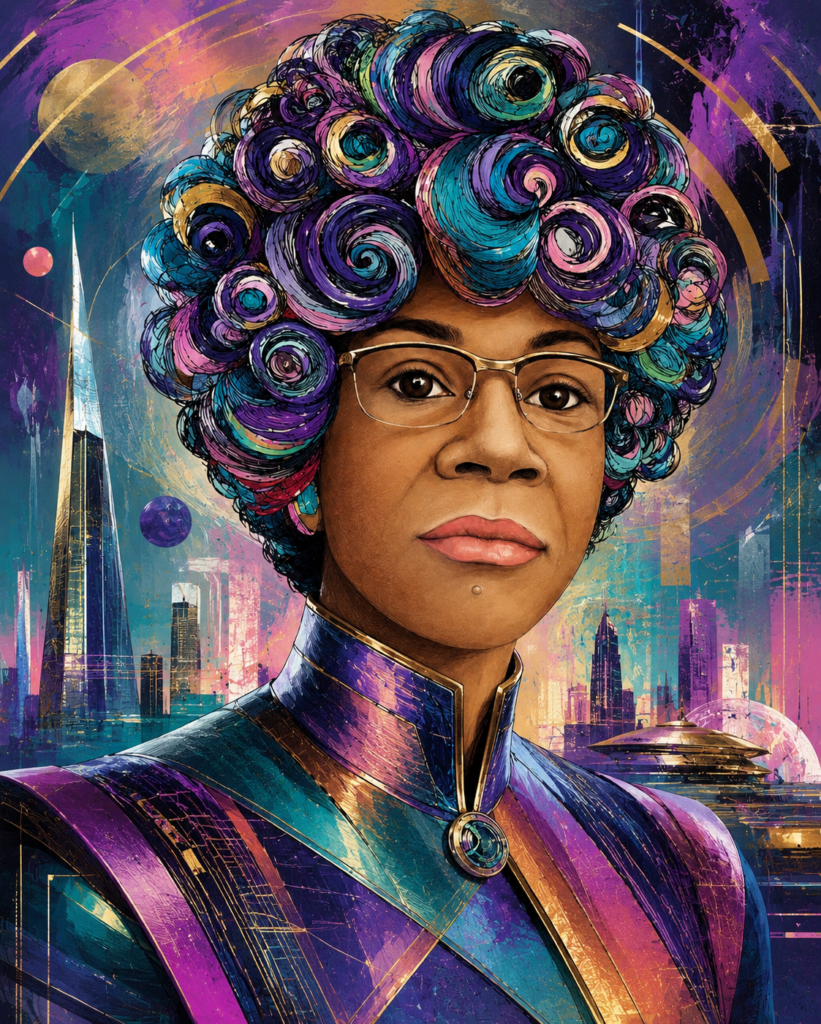
Shirley Chisholm was part of my life before I fully understood the importance of her political courage.
I lived in Brooklyn, New York, where she represented my congressional district. As a young art student, I won a citywide contest sponsored by CBS Radio Spot Sales. Shirley Chisholm saw an article about my achievement and sent me an official letter congratulating me. I never met her personally, but I still have that letter framed.
At the time, I understood it as recognition from my representative in Congress. Years later, I came to understand something deeper: Shirley Chisholm believed that achievement deserved to be seen and encouraged. Her letter made a young Black woman in Brooklyn feel that her accomplishment mattered.
Our paths also intersected through education. I later attended Columbia University, while Chisholm had earned her master’s degree in elementary education from Columbia University’s Teachers College. Her career began in education before she entered politics, and that background remained visible in her concern for children, working families, employment opportunity, and equal access to education.
In 1968, Chisholm became the first Black woman elected to the United States Congress. She did not enter that institution simply to occupy a seat. When assigned to a committee that did not serve the interests of her Brooklyn constituents, she challenged the assignment and demanded more meaningful work. That decision revealed the character that would define her public life: she was willing to question political customs when those customs limited her ability to serve.
Her 1972 campaign for the Democratic presidential nomination carried that courage onto the national stage. Chisholm understood that becoming an established presidential candidate required more than personal ambition. It required the steely determination to convince people that a Black woman’s candidacy was not merely symbolic, but politically serious and nationally relevant.
Her campaign forced the country to discuss what many considered impossible. Could a woman lead the United States? Could a Black woman be viewed as a national candidate rather than only a representative of Black interests? Could someone without the endorsement of the traditional political establishment still claim the right to seek the highest office in the nation?
Chisholm did not have to win the nomination to change the political process. By entering the race, she expanded the public imagination. She made it more difficult for political parties, journalists, donors, and voters to argue that women lacked the ambition, qualifications, or authority to pursue national leadership.
The later presidential campaigns of Hillary Clinton and Kamala Harris unfolded on ground that Shirley Chisholm had helped to open. Their campaigns faced different circumstances, but each encountered the continuing question of whether the American public is prepared to entrust the presidency to a woman. Chisholm’s contribution was to insist that the question be confronted rather than avoided.
She exposed both the possibilities and the limitations of American democracy. A democratic nation cannot claim to represent all its people while treating leadership by women—particularly Black women—as unimaginable. Chisholm challenged the political system to live up to its own promises.
Her famous declaration, “I am and always will be a catalyst for change,” described not only her personality, but also her historical role. A catalyst does not complete every transformation alone. It creates the conditions that allow change to begin.
That is what Shirley Chisholm did for American politics. She widened the doorway, strengthened the ambitions of the women who followed her, and made a Black woman’s presidential candidacy part of the nation’s political vocabulary.
For me, her legacy remains personal. The framed letter in my possession is more than a political keepsake. It is evidence of how recognition travels from one generation to another. Shirley Chisholm recognized my youthful achievement, and decades later, I recognize the magnitude of hers.
She taught this nation that political courage begins when someone is willing to ask, “Why not?”—and then possesses the strength and grace to stand inside the conflict that follows.
Article and Art by Lillian L Thompson
Website: https://lillianonline.us