
An Influential Global Afro Woman Who Dared to Fulfill Her Potential
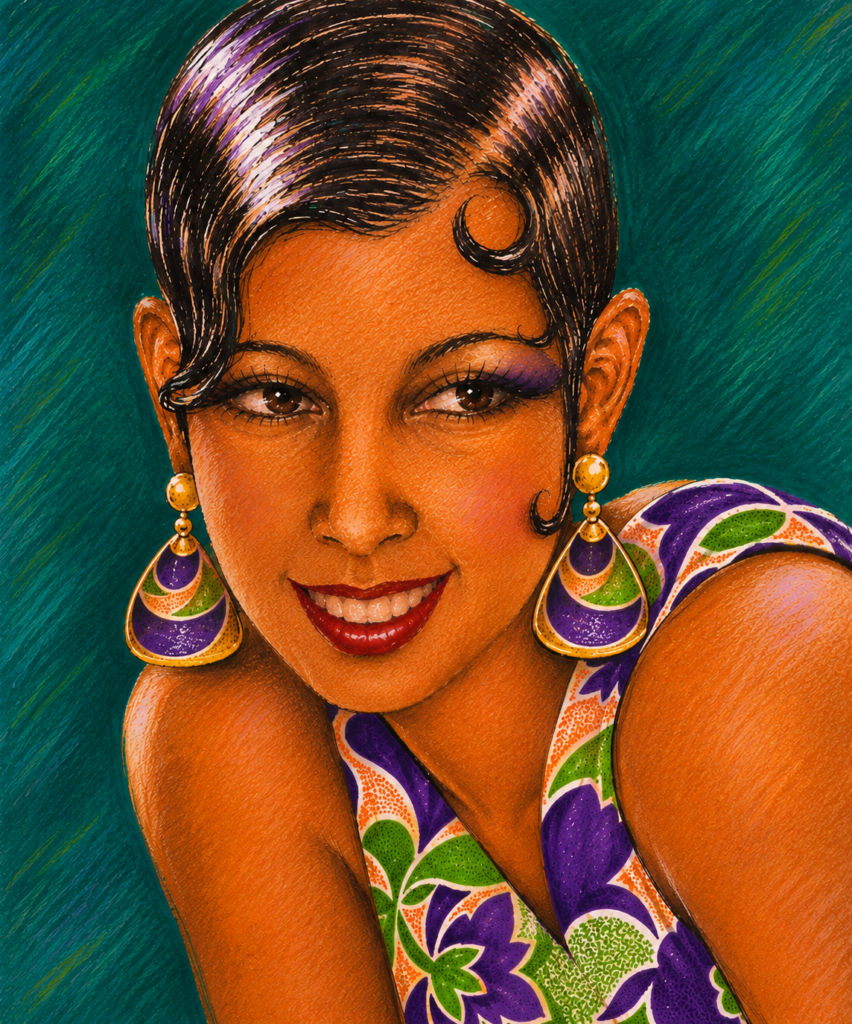
Narrated by Lillian Lenora Thompson | Approximately 20 minutes
There is something about Josephine Baker that fascinates me beyond her beauty, her extraordinary talent, or even her international fame. When I watch recordings of her performances, I am captivated by the ease with which she moves across the stage, the delicacy of her singing voice, and the warmth of her personality. She smiles, she laughs, she engages her audience as though they are old friends. Her happiness seems contagious. There is a naturalness about her, an almost effortless grace, that makes it difficult to separate the woman from the performer.
Yet behind that radiant presence was a woman whose beginnings offered little promise of the freedom and recognition she would eventually enjoy. Her life raises a question I have often considered in my own pursuit of creative and professional fulfillment: How much of what we become depends upon our determination, and how much depends upon finding an environment that recognizes and encourages our potential?
Josephine Baker was born in St. Louis, Missouri, in 1906, into poverty and the harsh racial realities of Jim Crow America. As a child, she worked in the homes of white families, performing domestic labor to help support her own. Her early years were marked by instability, limited educational opportunity, and the constant struggle to survive. In 1917, when she was eleven, racial violence devastated nearby East St. Louis, Illinois. White mobs attacked Black residents, burned homes, and drove families from their communities. The massacre became part of the world in which Josephine was growing up, a world where the security and dignity of Black people could be violently taken away.
What intrigues me is that these circumstances did not appear to diminish her appetite for life. She was drawn to entertainment, to movement, to the possibility of becoming something other than what her circumstances prescribed. She entered the world of vaudeville and traveling performance companies, eventually finding her way to New York and the creative excitement of the Harlem Renaissance.
Imagine that transition: a young Black woman emerging from poverty and racial hostility into a community alive with jazz, poetry, literature, theater, and dance. The Harlem Renaissance was more than an artistic movement. It was an extraordinary declaration of Black cultural identity and creative possibility. Josephine entered that environment with her own exuberance and determination, absorbing its energy while developing an increasingly distinctive performance style.
In chorus lines, where dancers were expected to move in disciplined unison, Josephine found ways to distinguish herself. She exaggerated movements, made faces, introduced humor, and attracted attention even when positioned at the end of the line. What might have appeared to be comic improvisation became part of her artistic identity. She was learning how to command an audience rather than disappear into the expectations of others.
Then, in 1925, at nineteen, she traveled to Paris to perform in La Revue Nègre (The Negro Revue). And there, her world changed.
I have visited Paris several times, beginning after my graduation from art school and returning on personal trips. Through its museums, cuisine, and the people I encountered, I developed an appreciation of French culture and its openness to sensuality, artistic expression, and the pleasures of social life. I can only imagine what it must have been like for Josephine to arrive during the Roaring Twenties, when jazz, modern art, fashion, and experimentation were transforming the city’s cultural life. She brought with her the rhythms, humor, and creative boldness of Black American entertainment, and Paris was fascinated.
Of course, that fascination was complicated. French audiences were captivated by images of Africa and Black sensuality, often filtered through colonial fantasies and racial stereotypes. Josephine’s early performances, including her famous banana-skirt dance, played directly into some of those expectations. Yet I wonder whether she understood more about this relationship than audiences realized.
Was she watching them watching her?
Perhaps she recognized their fascination and discovered that she could turn it into opportunity. The audience might have imagined it was observing an exotic spectacle, while Josephine was learning to shape that spectacle into a career, an identity, and a means of artistic independence. She was not free of the prejudices surrounding her, but she was finding ways to move beyond the limitations they imposed.
And she did move beyond them. The young dancer whose daring performances had astonished Paris developed into a sophisticated international entertainer, singer, film actress, and style icon. Her sculpted hairstyles, glamorous gowns, feathers, and theatrical presentation became part of the visual language of the era. Artists celebrated her. Audiences adored her. She moved among influential figures in European cultural life, developing the confidence and resources to pursue increasingly ambitious forms of expression.
What interests me most is not simply that she became famous. It is that she found an environment in which her imagination could flourish.
There is a profound difference between being noticed and being recognized. One can be noticed for being unusual, different, or entertaining without being respected for one’s abilities or individuality. Recognition offers something more. It acknowledges the possibility that a person has something valuable to contribute and deserves the opportunity to develop it.
Josephine’s success in Paris illustrates how transformative that recognition can become. Her presence helped establish a new image of Black female international celebrity, combining sensuality, elegance, humor, confidence, and theatrical daring. When I watch performers such as Shirley Bassey or Beyoncé, I see echoes of that commanding individuality. Their artistic styles are distinct, but each demonstrates how a woman can make her own personality, beauty, and creative authority central to her performance.
Josephine had helped expand the possibilities.
But her relationship with France would eventually reveal another dimension of her character. When World War II threatened the country that had become her home, she chose to serve it. Her celebrity, international travel, and access to influential social circles made her valuable to French intelligence and the Resistance. She gathered information, carried secret messages, and supported Allied operations, including activities in North Africa.
Consider the transformation. The same woman who had once used charm and theatrical presence to captivate audiences now used those qualities in dangerous circumstances where discretion and courage mattered far more than applause. She was risking her safety in defense of a country that had offered her opportunities she had struggled to find in the United States.
France would honor her wartime service with the Croix de Guerre and the Legion of Honour. Her achievements as an entertainer had already made her internationally recognizable, but her service demonstrated that her influence could extend beyond personal success.
I find that deeply meaningful. Recognition had given Josephine the freedom to develop her talents, and she had transformed that freedom into a sense of responsibility toward others.
Yet the contrast between her European recognition and her treatment in the United States remained painful. When Josephine returned to New York for the Ziegfeld Follies in 1936, she encountered an American entertainment establishment that did not embrace her with the enthusiasm she had known abroad. Despite her international fame, she was subjected to harsh criticism and the continuing indignities of racial discrimination.
Imagine the contradiction. Here was a woman celebrated in European theaters, welcomed into distinguished social circles, and recognized for her artistic achievements, yet in the country of her birth she could still be denied ordinary courtesies in hotels, restaurants, and public venues.
In 1951, a confrontation over service at New York’s Stork Club became a widely publicized controversy. For Josephine, such experiences were not simply personal insults. They exposed the injustice of a society willing to profit from Black talent while denying Black people equal dignity.
She refused to accept those conditions quietly. Using her standing as an international performer, she demanded integrated audiences and challenged discriminatory practices in the establishments where she appeared. Her professional influence became a means of insisting upon respect for herself and for the people who came to enjoy her performances.
There is something particularly powerful about that form of activism. Josephine understood that her presence had economic value. If an establishment wanted her talent, it could not expect her to overlook the indignities imposed upon others. She was using the authority she had earned to challenge the conditions under which Black performers and audiences were expected to participate in American cultural life.
Her commitment to civil rights became unmistakable on August 28, 1963, when she appeared at the March on Washington for Jobs and Freedom. Wearing her French military uniform and decorations, Josephine stood before an enormous gathering of Americans demanding equality and justice.
What an extraordinary image: the young girl who had grown up amid poverty and racial violence now standing in Washington as an internationally celebrated artist, decorated wartime veteran, and advocate for human dignity.
Her uniform represented recognition earned through service to France, but her presence at the march spoke to the unfinished struggle for freedom in the United States. She had experienced both the possibilities of recognition and the cruelty of exclusion. She understood what was at stake.
Following Dr. Martin Luther King Jr.’s assassination in 1968, accounts describe Coretta Scott King approaching Josephine about assuming a prominent role in civil rights leadership. Josephine declined, with responsibilities to her children among the reasons given. Whatever the precise nature of that invitation, her participation in the movement had already established her commitment to racial equality.
And yet, extraordinary achievement did not guarantee an easy life. Despite her considerable success, Josephine experienced serious financial difficulties in her later years and lost her beloved estate, Les Milandes. Her friendship with Princess Grace of Monaco became especially important during this period, providing support and a measure of stability.
I find this part of her story moving because it reminds us that creative fulfillment and public recognition do not eliminate life’s uncertainties. Even a woman who had achieved international fame, wealth, and extraordinary influence could experience financial vulnerability and loss.
But Josephine was not finished.
In April 1975, she returned to the stage at the Bobino theater in Paris for a celebration of fifty years in French entertainment. The performances brought enthusiastic audiences eager to see the woman who had become such an important part of their cultural history.
I imagine the satisfaction she must have felt returning to the stage where so much of her identity had been formed. She had lived through poverty, racial hostility, international fame, war, activism, financial reversals, and personal disappointment. Yet she could still stand before an audience and experience the connection that had first drawn her to performing as a young girl.
Only days after the opening, Josephine Baker died on April 12, 1975, at sixty-eight.
In 2021, France honored her with induction into the Panthéon in Paris, recognizing her contributions to French culture, wartime resistance, and the struggle for equality. Her remains stayed in Monaco, where she was buried, while a symbolic tribute took its place among France’s honored figures.
For me, Josephine Baker’s life is not simply an extraordinary journey from poverty to celebrity. It is a demonstration of how relationships, environments, and cultural climates influence our capacity to become who we might be.
We often speak of determination as though it alone guarantees success. But talent can be overlooked. Creativity can be discouraged. Individuality can be confined by traditions and prejudices that insist we remain within prescribed boundaries.
Josephine’s life suggests another possibility. Sometimes realizing our potential requires the courage to leave an environment that cannot recognize it and seek one in which our abilities can develop. Sometimes it requires the willingness to challenge the expectations of others, even when doing so involves uncertainty, rejection, or risk.
Paris did not free Josephine from every prejudice, nor did her achievements protect her from hardship. But she found opportunities to express herself, develop her talents, and become a woman of international influence. And as her influence grew, she increasingly used it to defend the dignity and freedom of others.
That is what makes her story so compelling to me.
As an artist and a Global Afro Woman, I recognize the importance of finding spaces where creativity is encouraged, individuality respected, and one’s contributions understood. We do not all seek the same forms of success, nor must we follow the same paths. But we share the human desire to discover what we are capable of becoming.
Josephine Baker’s greatest influence may not have been the way she danced, dressed, sang, or captivated an audience. It may have been her refusal to allow the limitations imposed upon her to determine the boundaries of her life.
She sought freedom, discovered recognition, and transformed her achievements into influence. Her life reminds us that self-fulfillment is not merely about what we accomplish for ourselves, but also about the possibilities our accomplishments create for others.
Josephine Baker was an influential Global Afro Woman whose courage to become herself helped expand the possibilities of what a Black woman could accomplish—and what the world might learn to recognize.
Lillianonline — Creating spaces of meaningful recognition and expanded understanding™
Josephine Baker: Freedom, Recognition, and Influence
Original illustrative portrait and essay by Lillian Lenora Thompson
Author narration by Lillian Lenora Thompson
© 2026 Lillian Online. All rights reserved.
website: https://lillianonline.us