
When I write about the decades of my life, I am not only recording what happened to me. I am also recognizing the people whose courage, professional excellence, and determination helped make my opportunities possible.
Some of these individuals were public figures whose names appeared in newspapers and history books. Others worked behind the scenes—in courtrooms, legal offices, churches, neighborhood meetings, and local branches of the NAACP. Their work reached families like mine, even when we did not personally know everyone responsible.
One of those extraordinary people was Constance Baker Motley.
An Architect of School Desegregation
Constance Baker Motley was one of the most important civil-rights attorneys of the twentieth century. Working with Thurgood Marshall and other lawyers at the NAACP Legal Defense and Educational Fund, she helped construct the legal strategy that challenged racial segregation in American education.
Motley wrote the original complaint in Brown v. Board of Education and helped prepare the legal arguments and briefs supporting the case. In 1954, the United States Supreme Court ruled that racial segregation in public schools violated the Constitution. The decision established the legal foundation upon which families and civil-rights attorneys could challenge segregated school systems across the country.
The ruling was historic, but it did not immediately open the doors of every segregated school. Southern states devised laws, administrative barriers, pupil-placement procedures, and other delaying tactics to resist integration. Virginia’s organized campaign became known as Massive Resistance.
The promise of Brown therefore had to be enforced through a sequence of additional lawsuits. Lawyers, parents, students, ministers, and local NAACP members continued pressing the courts to transform a constitutional principle into a lived reality.
The National Struggle Reached Arlington
My family became part of that continuing struggle in Arlington, Virginia.
In 1956, the NAACP brought Clarissa Thompson v. County School Board of Arlington as part of a broader effort to require Virginia school districts to comply with Brown. The litigation continued through repeated arguments, appeals, administrative procedures, and delays as the state resisted desegregation.
The legal arguments developed by Constance Baker Motley, Thurgood Marshall, and their colleagues at the Legal Defense Fund created the constitutional framework supporting cases such as Arlington’s. Motley worked on the major school-desegregation litigation handled by the LDF between 1945 and 1964, helping turn the victory in Brown into a national legal campaign.
In Arlington, families from the historically Black Hall’s Hill community argued that their children should be permitted to attend nearby schools rather than be transported farther away to maintain segregation. Stratford Junior High School was close to their community, but Black children had been excluded from attending it because of their race.
The admission process was not simply a matter of living nearby. Black students were subjected to demanding evaluations and were selected partly on the basis of their strong academic performance. They were expected to demonstrate that they were exceptionally qualified to enter a school that white students could attend as a matter of course.
That unequal burden is important to remember. These children were not merely going to school. They were being asked to help dismantle a system.
My Sister Was One of the Four
On the morning of February 2, 1959, my sister, Gloria D. Thompson, entered Stratford Junior High School with Ronald Deskins, Michael Jones, and Lance Newman. Together, they became the first Black students to desegregate a public school in Virginia.
Gloria was the only girl among the four.
Their entrance into Stratford was the visible moment that followed years of legal preparation, community organizing, family sacrifice, and resistance to Virginia’s efforts to preserve segregation. Police officers were present because no one could be certain how the students would be received. The children had to walk into the building carrying not only their books, but also the expectations and anxieties of an entire community.
The day proceeded without the violence that many had feared. Yet the absence of a public confrontation should not cause us to underestimate the courage required. Four children entered a school from which the law, the government, and local custom had previously excluded them.
They did so knowing that their presence would be watched, examined, and judged.
The Work Continued After the Doors Opened
The integration of Stratford did not mean that Arlington’s schools suddenly became fully integrated. It represented an essential beginning.
Additional cases and court decisions were still required before more Black students could attend schools near their homes. Families continued challenging pupil-placement requirements, transportation practices, and policies that allowed integration to proceed slowly and selectively.
The first four students carried a particularly heavy responsibility because officials and observers would use their experiences to assess what might happen next. Their academic performance, conduct, appearance, and ability to withstand pressure were scrutinized in ways that white students did not experience.
Once the case was won, another kind of work began: preparing the children, their families, the faculty, and the schools for the actual experience of integration.
This is one of the lessons often lost when history is reduced to court decisions and dates. A legal victory may open a door, but human beings must still walk through it. Communities must prepare. Children must find their courage. Parents must place their children into environments where they cannot fully protect them. Teachers and administrators must decide whether they will uphold the spirit of the law or merely comply with its minimum requirements.
My Mother, the NAACP, and Our Family’s Place in History
My mother was involved with the local NAACP, so the movement was not an abstract political event in our household. It was connected to meetings, conversations, legal strategies, community responsibilities, and decisions that affected our family directly.
As Gloria’s little sister, I witnessed the consequences of that work from inside the family.
At the time, I could not have understood the complete network of people whose efforts helped make my sister’s entrance into Stratford possible. Local families and organizers were connected to Virginia NAACP attorneys, who were connected to the broader legal movement shaped by the LDF. Behind the students walking into the school stood years of research, briefs, arguments, judicial rulings, appeals, planning, and sacrifice.
Constance Baker Motley was part of that larger network of legal courage.
Her contribution to Brown helped establish that segregated public education was unconstitutional. Her subsequent work helped enforce desegregation throughout the South. Although the Arlington litigation had its own local attorneys and history, the constitutional path they followed had been built through the national campaign in which Motley played a central role.
That is how her life intersects with mine.
A Woman Working at the Height of Her Profession
Constance Baker Motley’s accomplishments were extraordinary under any circumstances. They are even more remarkable when we consider the racial and gender discrimination she faced throughout her career.
Born in New Haven, Connecticut, in 1921, Motley graduated from New York University and earned her law degree from Columbia Law School in 1946. She began working with the Legal Defense Fund while she was still a law student and eventually became one of its principal trial attorneys.
She traveled throughout the segregated South, entering communities where her work exposed her to hostility and physical danger. She represented students seeking admission to segregated universities, civil-rights demonstrators arrested for peaceful protest, and activists challenging discrimination in transportation, restaurants, parks, and other public facilities.
She directed the legal campaign that secured James Meredith’s admission to the University of Mississippi. She also represented Martin Luther King Jr. and helped protect the rights of children and adults participating in civil-rights demonstrations.
Motley became the first Black woman to argue before the United States Supreme Court. Of the ten cases she argued there, she won nine.
Her career then expanded from law into elected office. In 1964, she became the first Black woman elected to the New York State Senate. In 1965, she became the first woman to serve as Manhattan borough president. President Lyndon B. Johnson appointed her to the United States District Court for the Southern District of New York in 1966, making her the first Black woman to serve as a federal judge. She later became chief judge of that court.
Each achievement was historic. But to me, her importance cannot be measured only by the number of “firsts” attached to her name.
Her greatest legacy may be found in the lives that unfolded differently because she did her work well.
The Difference Between Knowing History and Living It
I did not experience Brown v. Board of Education only as a chapter in a history book. Its meaning entered my household.
I saw its consequences through my mother’s NAACP involvement, my sister’s preparation, and Gloria’s entrance into Stratford Junior High. I grew up during the transition from legally enforced segregation toward the still-unfinished promise of equal opportunity.
The work of Constance Baker Motley and her colleagues affected where children could attend school, what education they could receive, and what futures they might imagine.
Their victories also shaped my path.
The opportunities I later pursued—as an artist, designer, student at Pratt Institute, graduate architecture student at Columbia University, and professional woman—were connected to a larger movement that had challenged the limits imposed upon Black children and their families.
That does not mean discrimination disappeared. It means that people before me fought to widen the field of possibility.
Recognition Is Part of the Work
Constance Baker Motley spent much of her professional prime doing work that benefited millions of people who would never meet her.
Many families may know that Brown v. Board of Education changed the law without knowing the full extent of Motley’s role in developing its legal strategy. They may know the names of the students who integrated a particular school without knowing the women who researched, drafted, organized, argued, and persisted behind the scenes.
This is why recognition matters.
Recognition is not merely praise. It is the restoration of people to their rightful place in the story.
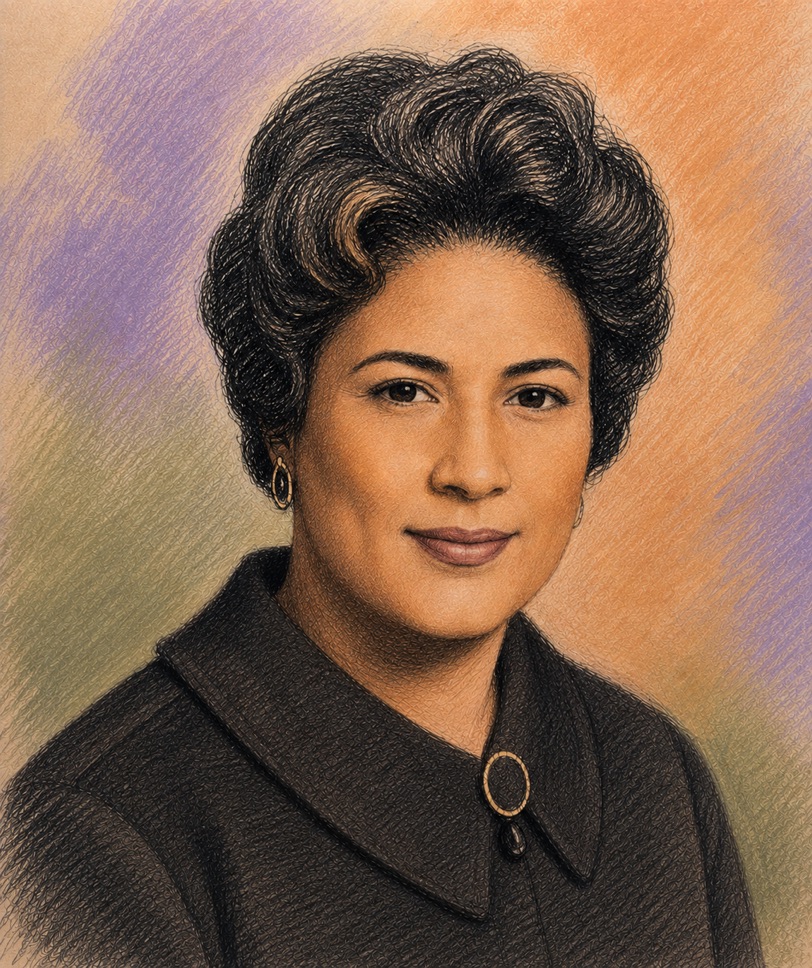
When I create an illustration of Constance Baker Motley, I am not simply reproducing a historical photograph. I am interpreting a woman whose disciplined presence, intelligence, and professional authority helped change the country. The visible pencil lines connect the finished portrait to my own hand as an artist. Her conservative clothing reflects the dignity and restraint expected of a Black professional woman navigating institutions that often questioned whether she belonged.
The portrait asks us to look again.
It asks us to recognize the woman behind the legal briefs, the courtroom arguments, and the judicial robe.
Her Work Reached Us
Constance Baker Motley may not have known my sister Gloria personally. She may not have known my mother or the children growing up in Hall’s Hill.
But her work reached us.
It reached the four students who entered Stratford Junior High School on February 2, 1959. It reached the students who followed them. It reached families who no longer had to accept that their children should be transported past a nearby school simply because they were Black.
And it reached the little sister who watched these events become part of her family’s history.
That is how movements work. A legal argument developed in one office reaches a courtroom. A decision from that courtroom reaches a community. A community sends four children through a schoolhouse door. Decades later, one of their family members creates a portrait and tells the story.
Constance Baker Motley helped open that door.
The responsibility now belongs to us to remember who built it—and to recognize the courage of those who walked through it.
Article and illustration by Lillian L. Thompson,
Website: https://lillianonline.us